Showing posts with label g-skill. Show all posts

Saturday, November 15, 2014

Build Log: Intel i7-4790K + Gigabyte Z97X-UD5H

Put together a new rig to form a core gaming and test machine.

CPU: Intel i7 4790K Motherboard: Gigabyte Z97X-UD5H RAM: G-Skill Ripjaws 2x8GB 2133MHz SSD: Plextor M5-Pro 256GB (already owned) HDD: Old one ODD: Old one Case: Fractal Design Arc XL PSU: EVGA SuperNova G2 750W

Fractal Design Arc XL

First up is the impression of the case, the Fractal Arc XL, big-brother to the Arc Midi I used last month.

It's a big spacious case, looking very similar to the Midi. The top panel has a couple of extra USB ports.

Also comes with a bucket load of screws and a few cable ties. A few notes on the XL from during and after the build:

  • Just like the Midi, the XL is great to build in. Spacious, good quality all round.
  • The feet on the case come with stoppers that don't slide very well. My machines sit under a desk, and when sliding it in place one of the stoppers came off.
  • The built-in fan controller requires a 4-pin molex power connector. I had to connect a dedicated cable to the PSU purely for the fan controller.
  • The HDD caused the front panel to buzz/vibrate. I had used the rubber anti-vibration rings to install the HDD, but had them done too tight. After loosening them off, the noise went away.
  • The PSU is mounted on rubber stands &emdash; haven't seen that before.
EVGA SuperNova G2 750W

Made by OEM SuperFlower, I got this guy on the back of some really strong reviews at JonnyGuru and TechPowerup.

SuperNova G2 in box, loads of cables

Comes with a lot of cables and velcro cable ties. The modular cabling is nice, but as above with the fan controller, sometimes you need to use "just one more" for that extra little thing you need to connect.

Out of box

Mounting it was painless. As noted above the XL has rubber mounts for the PSU to sit up on.

I can only assume this is for a little extra airflow to the PSU fan.

SuperNova G2 mounted. Mind the gap

Gigabyte Z97X-UD5H

I kinda knew that while this was a solid board, it had a potential issue at stock speeds with an unlocked chip like the 4790K. Thought I'd give it a go anyway.

Gigabyte Z97X-UD5H

It's a nice looking board with lots of features. Only thing of note really is that it was somewhat thinner than I expected. It felt no different to other cheaper boards like the H97 line, whereas I've heard it claimed in the past that the PCB on expensive Z boards is thicker. Didn't seem to be the case, but then I didn't pull out any of my older (cheap) boards to do a direct comparison. The board is plenty strong enough though.

Update 21/11/2014:Should note there is an issue with the UD5H and the 4790K at stock settings — details at this thread.

Initial Build/Setup

Putting it together, it was a nice case to use with plenty of cable routing options. Finished product looks fairly neat even without tying any of the cables down.

Obviously there are two big omissions from this initial setup:

  • It's using the stock cooler. I've got an aftermarket cooler to put on, but my plan was to test out the stock cooler with the 4790K and UD5H. Will document later.
  • There's no GPU. That's still to come. I was trying to track down an MSI GTX970, but they're pretty difficult to come by. Instead will probably get my hands on the Gigabyte G1 Gaming. :)

Monday, October 6, 2014

Build Log: Fractal Midi R2, i5 4590+H97

Putting together a new machine for a friend. This is its story...

First up, the list of parts used:

CPU: Intel i5 4590 CPU cooler: Coolermaster Hyper 212 Evo Motherboard: Gigabyte H97-D3H RAM: G-Skill Ares 2x4GB 1600MHz SSD: Plextor M5S 256GB HDD: Seagate 2TB 7200RPM ODD: Lite-on DVD-RW Case: Fractal Design Arc Midi R2 PSU: Antec True Power Classic 550W

The usual suspects

Initial reaction to the Fractal Define Arc Midi R2 is that for a mid-sized case, it's...big. At least, it's very wide. Good for big CPU coolers if needed (180mm of clearance).

The Fractal Design Arc Midi R2

The case has some nice features, including an in-built fan controller for up to three fans. The switch for fan speed levels is built into the front of the case. Switching between the speeds after completing the machine, at 12V the fans audible but not too noisy, while down at 5V they're barely audible at all.

Arc Midi R2 front panel connectors, including fan controller switch

The R2 comes with a bunch of screws, cable ties and risers as you would expect. Below is the inside of the case with both side panels removed. If there was a blemish with this case, it was that one of the side panel screws felt slightly cross-threaded when first undone. Very minor in the scheme of things, hardly worth even saying, but I liked everything else about the case :)

On to the rest of the components. CPU is the i5-4590, motherboard is the Gigabyte H97-D3H. Both solid mid-range options for a non-OC machine.

The Gigabyte H97-D3H

I've heard people say that when installing an Intel CPU for the first time, they get a bit scared by the sounds that the lever used to hold the CPU in place can make. It can make creaking sounds, but this is normal in my experience. It is applying a fair bit of force, since it needs to keep the CPU absolutely stationary in its socket.

The i5-4590 in place in the motherboard

Next I installed the RAM and cooler. I did this outside of the case, but that turned out to make accessing the top left of the motherboard awkward when screwing it in place (fat fingers!). Putting the motherboard in first and then mounting the cooler (there is a cutaway behind the motherboard that lets you do this) would have been easier. And while this is a non-overclocking machine — and so the stock cooler would have sufficed — for a little extra quietness I got the aftermarket cooler.

Motherboard with RAM and cooler installed

Adding the other components to the case was fairly straightforward. The drive bays all have rubber sound-reducing grommets to screw hard drives into, and mount points for SSDs. Cable management was an absolute breeze in this. I think I only used two of the cable ties that came in the box, the rest more or less managed itself. I'm far from great at cable management, but this case made it really easy.

The finished product...almost

The picture above is the complete machine, minus the graphics card, which I'm waiting on for stock. Intending on a GTX970, hopefully an MSI model so it will fit without needing to remove the top HDD cage. The loose cable at the bottom of the case is the PCIe power connector for the GPU. I'll post an update when the GPU is in. Currently the machine gets about 10FPS on the Unigine Heaven benchmark the poor dear. I'm sure a GPU will help out a little there.

Update: Addendum for the GPU installation.

Wednesday, January 16, 2013

Building i5-3470: Summary

The following is a summary post for my i5-3470 build. Unfortunately a lot of the photos didn't turn out all that well, which will teach me for using my phone instead of a real camera. Oh well.

Part 1: Build Overview

Over Christmas 2012 I gathered together parts to build a new computer.

Group shot!

Machine requirements: general purpose day-to-day workhorse. Needs to be able to do most tasks from email/internet, document/artwork creation, software development, light gaming, virtual machines and (possibly) animation rendering. The last two are not going to be often, but it'll need to handle them.

Chosen parts (desktop box):

  • Case: Corsair 300R
  • PSU: Antec Neo Eco 520C
  • Motherboard: ASRock H77 Pro4/MVP
  • CPU: Intel i5 3470
  • RAM: G-Skill Ares 2x4GB
  • SSD: Samsung 830 128GB
  • HDD: Seagate Barracuda 2TB
  • ODD: Samsung 22x DVD R/W
  • OS: LinuxMint 14 (Cinnamon) [since ditched in favour of Xubuntu 12.10]

The Corsair 300R

Accessories (some added post-build):

  • Monitor: Dell U2412M (24" IPS)
  • Keyboard: Ducky DK9008 Shine II (Cherry Browns)
  • Mouse: Logitech G400

(Yes, I splashed out on an expensive keyboard. Don't you judge me!)

Part 2: Case and Power Supply

After unboxing the case and the power supply, I had a couple of minor conerns:

  • The case had a blemish on the inside about where the motherboard would sit (see image). While it might have been an indication that the case was a return and not brand new, everything else seemed fine and I'm not really sure what difference a "returned" case would make. Also, this could have just been a manufacturing thing anyway.

    Corsair 300R with minor blemish on interior

    This pic also shows up the "bump risers" in the 300R, which comes up later.
  • The box the PSU came in was a little bit beat up, but there was nothing on the inside that made me think it was anything but new.

    The Antec Neo Eco 520C

The first step is to mount the PSU in the case and screw it in. This immediately led to the question: PSU fan up or fan down? A quick web search suggested that down may be slightly better (potentially lower temps on the system, but also someone pointed out you're less likely to drop small items like screws into the fan).

The 300R has a bottom vent, so I decided to go with "fan down".

Case with PSU installed

Next potential concern: there was no voltage selector on the Neo Eco 520C. Other (cheaper) power supplies I've used have had selectors. The lack of one suggested that the Antec could handle either 115V or 240V, and reading the labelling confirmed this. So there was no need to "select" an option.

It's also worth noting that the Antec Neo Eco 520C (and I guess all Neo Ecos?) doesn't come with a power cable. For me this wasn't a problem since I had half a dozen laying around, but might be a problem for some people.

Part 3: Motherboard Installation

Some people like to install the CPU/heatsink/RAM before putting the motherboard into the case. I just whacked the motherboard in there right up front, mainly because I didn't have a place where I felt comfortable putting it to then push and prod other parts into it.

The first issue I had with the motherboard was: where are the motherboard risers? The Corsair 300R only came with one motherboard riser in the pack of screws. This confused me, since in the past the cases I'd used needed at least half a dozen risers to prop the motherboard up so it wouldn't touch the case and short out.

It turns out that the 300R has "bump" style risers, where you don't actually need to screw in anything. Convenient...once you know about it.

Motherboard with CPU installed

After that, the CPU went in without an issue. It can only go in one way, you just have to line up the bumps and indentations. The heatsink/fan was a different story.

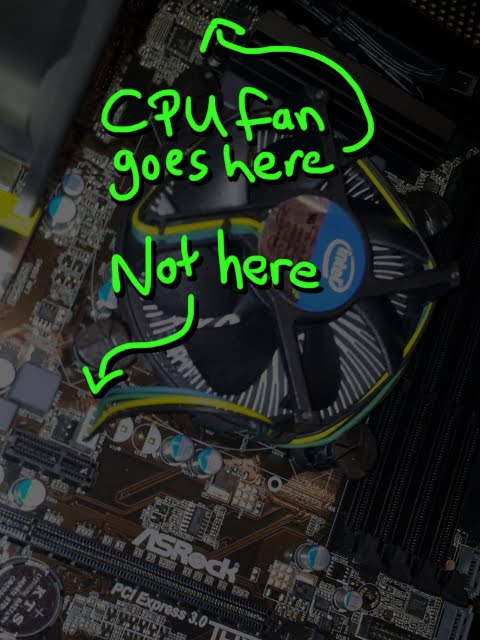
I've done it a couple of times now, so I seem to have a knack for seating the heatsink in such a way that the power cord for the CPU fan won't reach the spot on the motherboard where it plugs in. This time I misread the "CHA1 fan" as "CPU fan", and seated the heatsink accordingly. After realising my mistake, I pulled it off and rotated 90 degrees so it would plug into the correct spot. (Technically, since I pulled the heatsink off after being seated on the CPU, I should have redone the thermal paste, but since the machine hadn't ever been powered up, I felt it wasn't that much of a risk. But I noted it to check the temps first thing after powering on).

CPU fan plugged into wrong spot

The only interesting thing with the RAM is that the ASRock motherboard doesn't colour-code the slots like, say, a Gigabyte motherboard. But to use dual-channel, the RAM goes in the same way (that is, leave a gap between the RAM sticks to run in dual-channel).

Motherboard with RAM installed

Part 4: Plugs, Cables and Initial Bootup

Next was to plug in all the drives (DVD, HDD, SSD), case fans and the front-of-case switches, LEDs and USB cables.

Corsair 300R cable management (back view)

The cabling with the 300R turned out fairly nice, with the USB3 and leftover molex/PCI power cables being the most obtrusive. It really helps having someone else around to hold and adjust cables from one side while you're trying to tie them (thanks Dad).

Corsair 300R cable management (front view)

That brings us to the moment of truth: the first power on.

I flicked the switch and passed the first test: it didn't explode. However, the power cables for the CPU fan were wound so tightly around the heatsink that they caught on the fan and prevented it from spinning. This has happened almost every time I've installed an Intel stock fan, so from now on I check this before turning on.

After noticing the fan not spinning, I shut down straight away. Even though the CPU should protect itself from overheating and kill the power, it's not something you want to risk if you don't have to. I rearranged the wires of the CPU fan and everything went okay on the next powerup.

I'd forgotten that I had a Bodhilinux distro installed on the SSD from when I tested it out in a previous machine. When I turned it on (in this completely new build), it ran up without a glitch.

Initial impression of the sound is that the stock CPU fan is a little louder than the i3 3220. May have just been imagination, or something to do with re-seating it, but it's still a bit louder than what I was expecting/hoping for.

Build complete

Overall, pretty happy with the build. Next step is installing (and experimenting) with a GPU while running Linux.